
Over 3+ years, I’ve worked with faculty at Carnegie Mellon University to make data- and research-backed improvements to human-computer interaction courses — both academic courses and professional level certificate courses.
While I’m not able to publish assets that are designed for enrolled students, I can share my insights and process for designing courses.
Capacity: Full-time work
Duration: 3+ years
Role: Learning Engineer
Collaborators: Faculty subject matter experts, peer reviewers
Tools: Canvas, DataShop, Figma, OLI Torus, Piazza
Methods: Backward design, data-driven iterative course improvement, knowledge component analysis
The Context
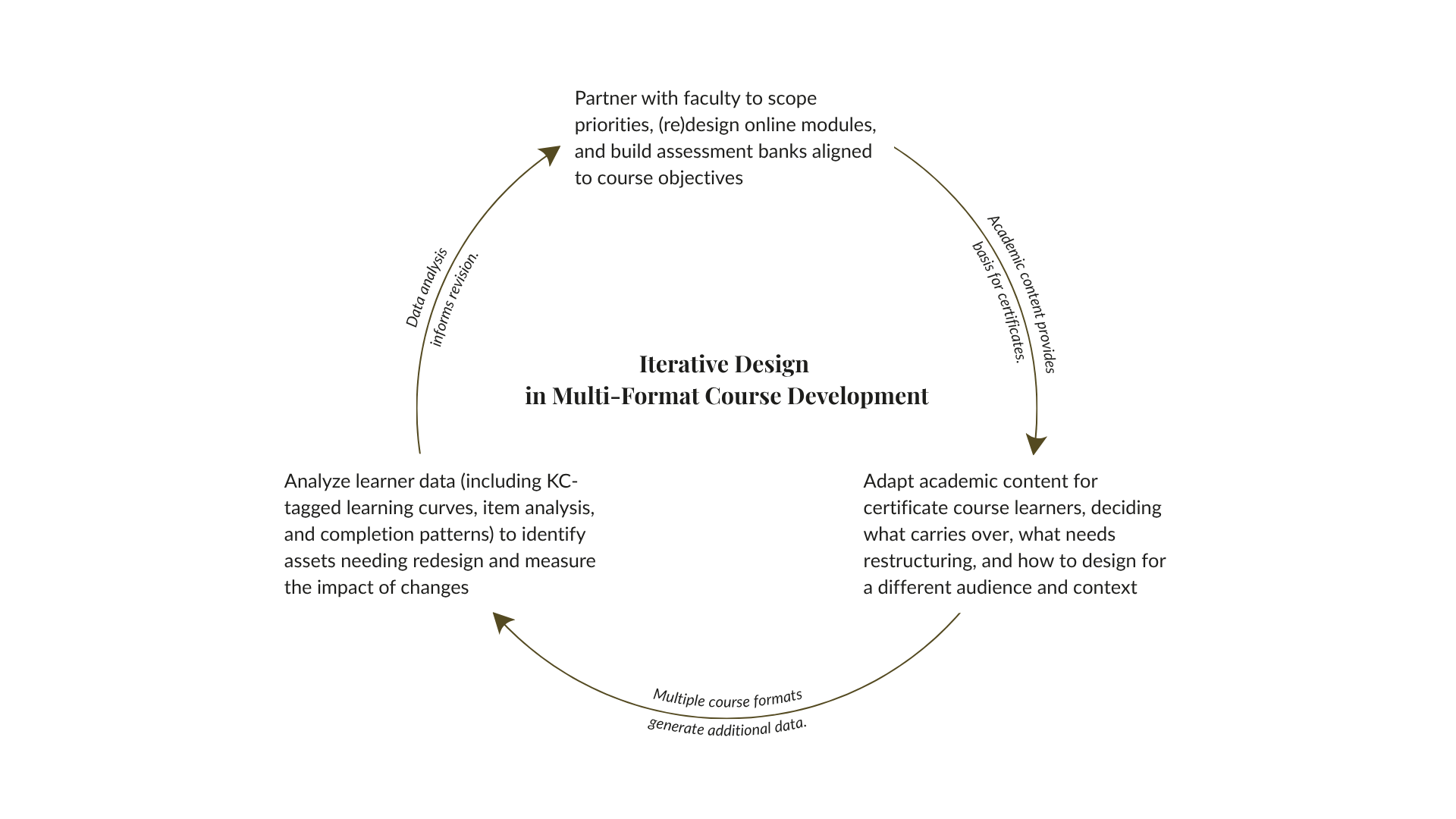
I work within the Human-Computer Interaction Institute to iterate on several courses spanning interaction design, learning analytics, online learning tools, data science, and educational design. My role involves two parallel tracks: improving the academic course experience with faculty subject matter experts, and adapting those materials into certificate courses for learners outside an academic context. This process is rarely linear. Learning engineering is iterative by nature, and is shaped by faculty priorities, learner data, and the constraints of each course’s audience, platform, and subject matter. The diagram below illustrates my overarching workflow.
Over time, and through working with a variety of stakeholders and subjects, I’ve developed working theories about what makes learning engineering actually work. The reflections below capture patterns I’ve noticed, and what I’ve learned about building durable learning experiences.
Learning science principles themselves are a stakeholder.
This is the backbone of my approach to stakeholder management: my first obligation is to do what I know is best for learning. Some might say that in learner-centered design, our first obligation is to learners. I think it’s to learning. A learner-centered approach is not the same as a learner-directed one. Of course, stakeholder management involves multiple stakeholders. The weight you give to different stakeholders can fluctuate depending on the project, but learning science principles always need to have a prominent seat at the table.
We can apply what we know about learning to how we work, not just what we build.
Learning engineers are uniquely equipped with the skills to efficiently communicate complex information, align workflows with personal or team goals, and analyze whether our work has the intended impact. I have applied learning science principles when onboarding faculty to educational tools, designing internal documents, and creating project plans. We know what works. Using that knowledge in the behind-the-scenes work in addition to learner-facing work can make us more effective day-to-day, and gives us that much extra opportunity to hone our craft.
Constraints keep us sharp.
Adapting an academic course into a certificate offering is one of the most useful stress tests I’ve encountered in this role. More than once, the work of building a certificate course has surfaced gaps I would have missed if I had kept iterating only within the academic context. Any new constraint (a different audience, a new platform, a time crunch) forces you to look at the same material through a different lens. Without those creative challenges, it’s easy to slip into procedural autopilot, applying the same process everywhere because it’s familiar, not because it’s the right fit.
New constraints also tend to push you back into the research. When I’m working in a context I haven’t before, I end up reading more deliberately and updating my practice. The discomfort of new constraints is, in retrospect, where most of my growth as a learning engineer has come from.
More Information
You can find the certificate courses my team and I developed here.