I led a 5 person team in creating onboarding and personalization features for Pathway2Careers, an edtech platform helping high school students explore career paths.
Capacity: Coursework (50 combined units)
Duration: 9 months
Role: Project Manager
Collaborators: Princy Sasapara (Product Manager), Jiaqi Zhang (Development), Ziwen Zeng (Research/Design), Shang-Yuan Wang (Research/Design)
Tools: Figma, Google Sheets (project management), Miro
Project Management Methods: Backlog-driven issue management, hybrid agile/scrumban, iterative prototyping, work breakdown structure (WBS)
Research & Design Methods: Affinity diagramming, brainwriting, card sorting, competitive analysis, heuristic evaluation, literature review, storyboarding, usability testing, user interviews
The Context
Pathway2Careers (formerly NS4ed) is an education company focused on career-connected learning. They hired a team of master’s students from Carnegie Mellon University’s METALS program — our team, Altus — for a 9-month project to improve their tool. We were given a broad problem space: supporting students in becoming aware of employment opportunities within their communities. The underlying premise was that career-connected learning, combined with guidance and tools to identify strong career destinations, can prepare students for employment success.
Our hunt statement: Empower learners to achieve employment success by improving the existing career-connected learning program, through designing effective means of boosting motivation and participation in the program.
Project Management Methods
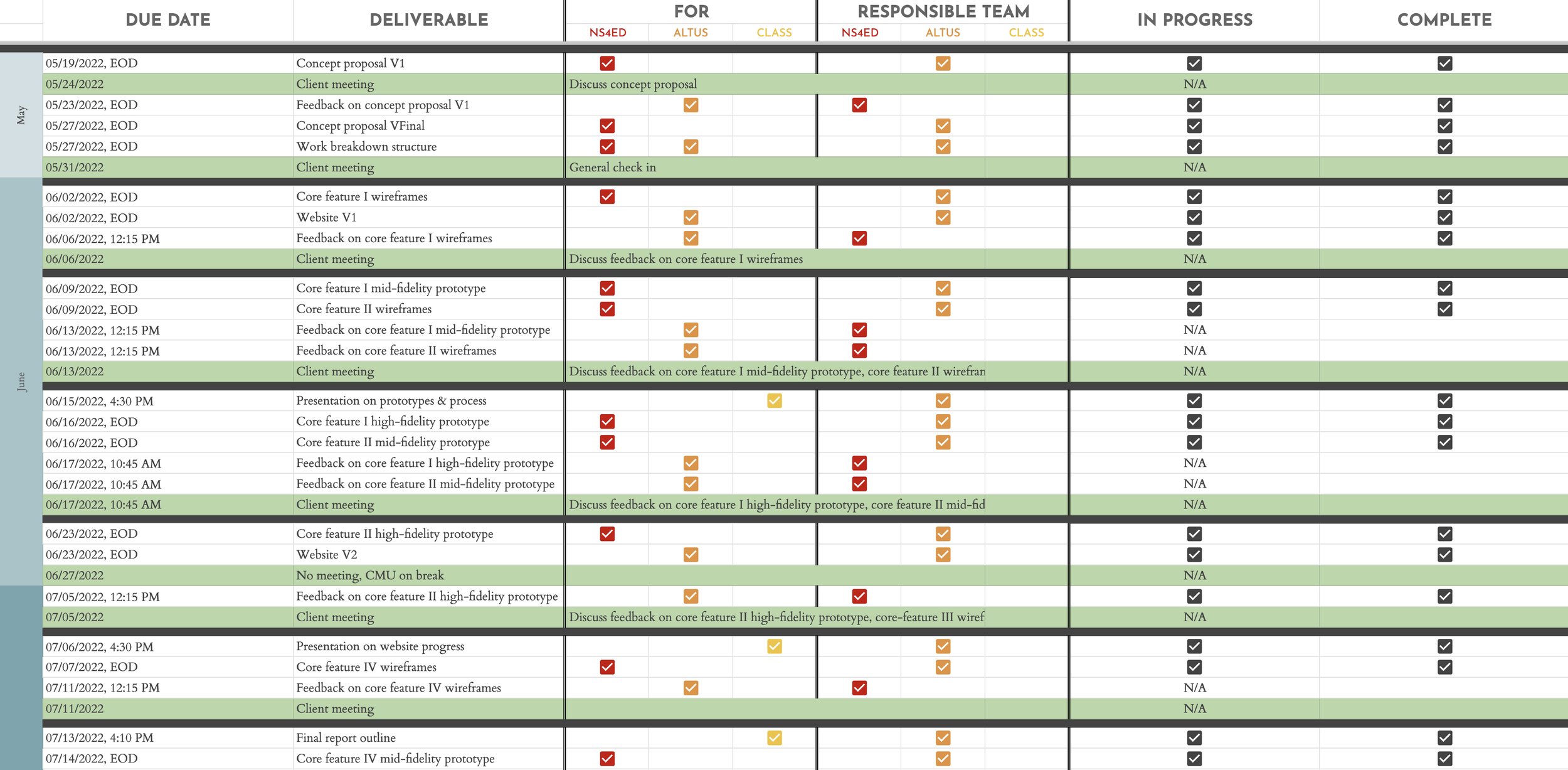
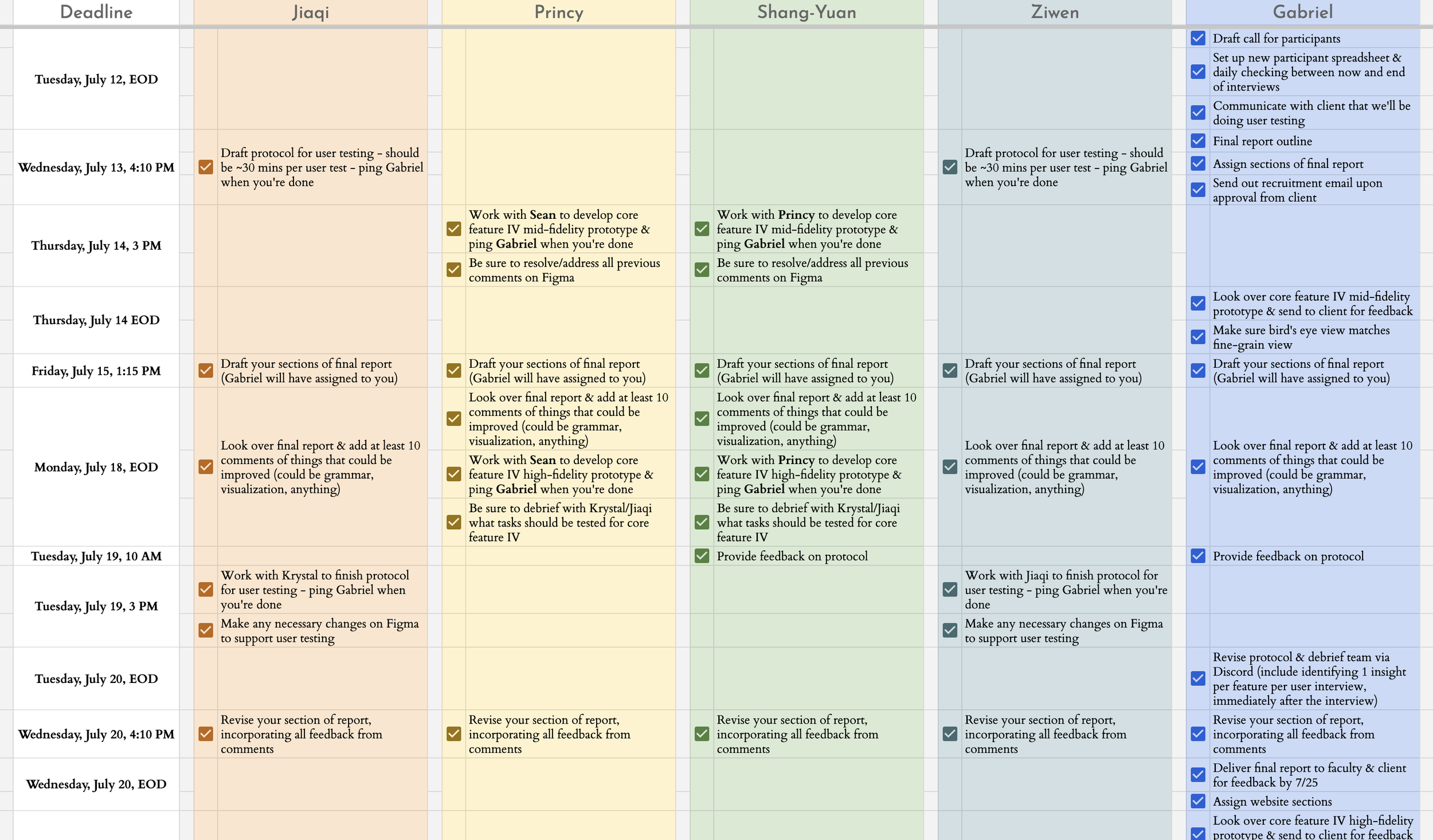
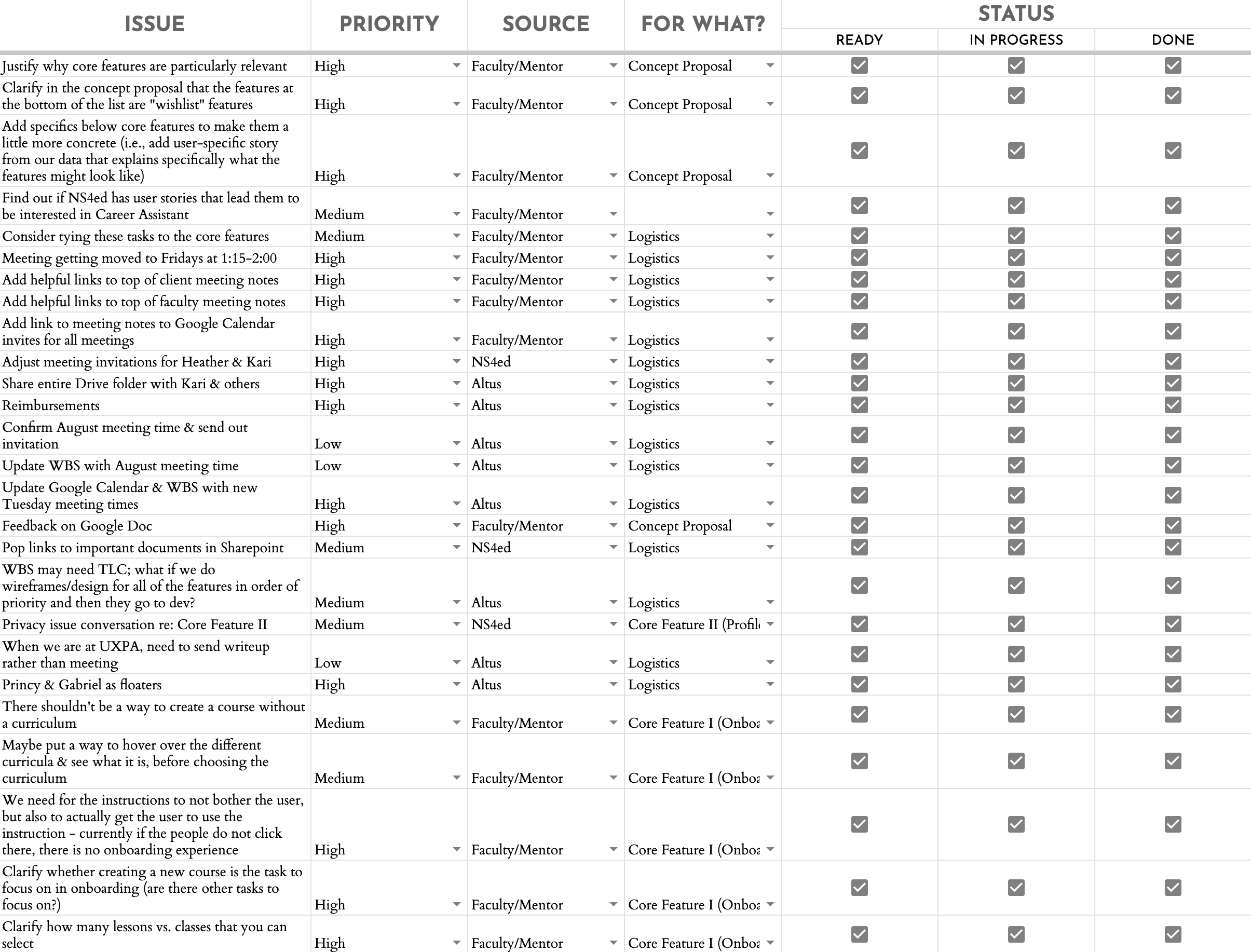
Managing this project meant coordinating across multiple audiences: our external client, our internal team, faculty and alumni mentors, and our capstone class. We needed a system that could give different views to different stakeholders without requiring anyone to onboard to a new tool. I tried a number of project management platforms over the first few months (including Taiga, Jira, TickTick, and Trello) before consolidating on Google Sheets. Sheets was easy to use, easy to share, and required no client onboarding. Its flexibility let me build the views each audience actually needed: a bird’s eye milestone view, a backlog for issues and feedback, and a fine-grained task view for individual team members. These three views are shown below. I held weekly one-on-ones with each team member, facilitated client and team meetings, and updated our workbreakdown structure nearly daily.
Research
We conducted a literature review, competitive analysis, heuristic evaluation, and card sorting to map the existing landscape and surface usability issues with the current tool. We also completed 13 IRB-approved user interviews with teachers and students to discover the motivational elements behind their use of Pathway2Careers and to evaluate the platform’s usability.
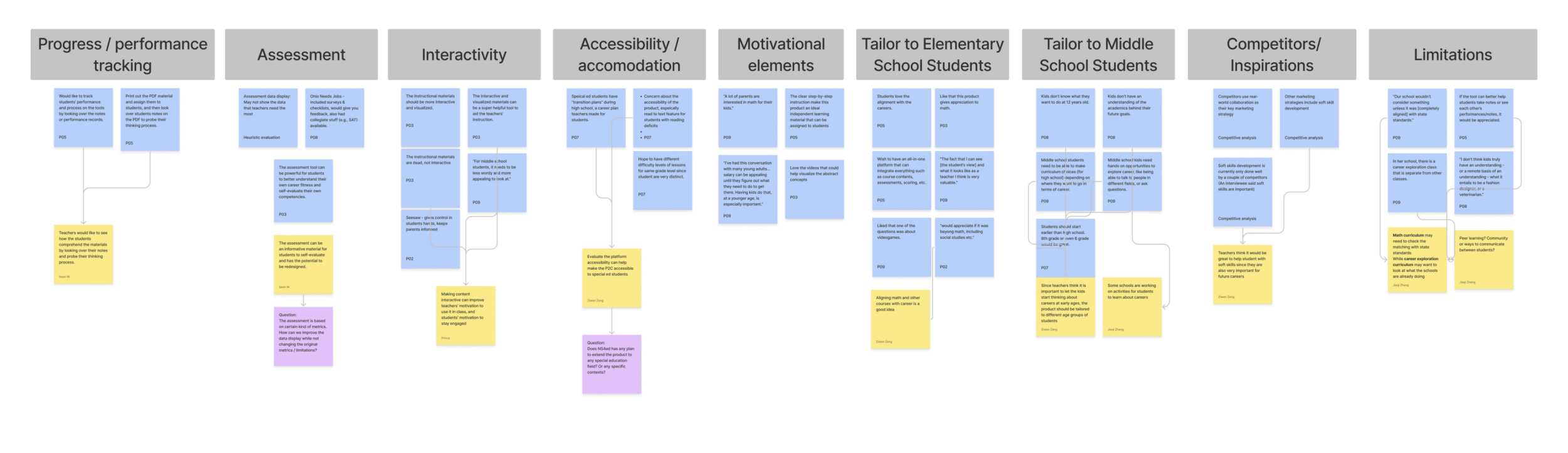
We synthesized findings using affinity diagramming (shown below), which produced four key insights:
Teachers need an easy-to-search and easy-to-export format for P2C materials.
Teachers want P2C to be more interactive and include more hands-on activities.
Teachers and students want career-integrated lesson plans for subjects beyond math.
Students need career information that goes beyond labor market data.
Ideation
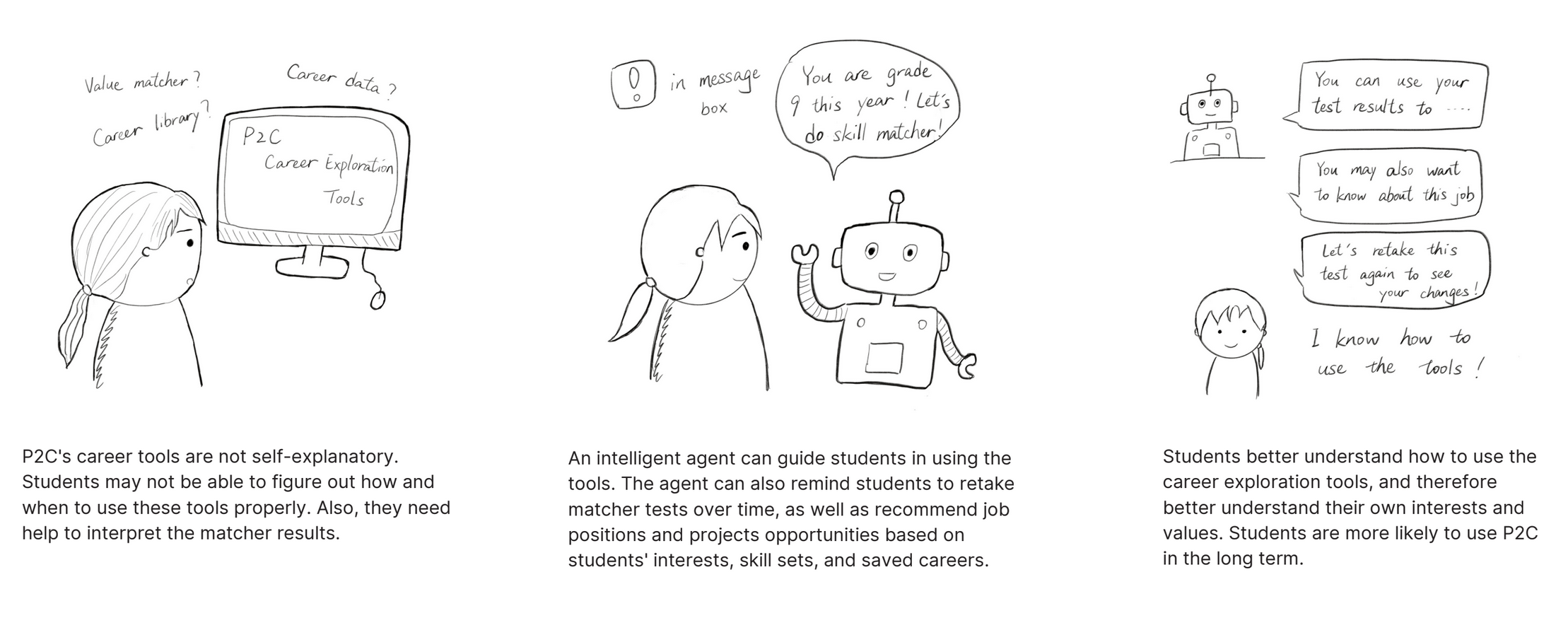
To translate insights into possibilities, I facilitated a structured brainwriting session that produced 75 ideas. We narrowed these to a viable subset and developed five storyboard pitches to present to the client, each representing a different direction the work could take. An example storyboard for the pitch “Career Assistant” is shown below.
Client Communications
By this point, we’d been communicating with the client for a few months, but choosing among five viable pitches required a different kind of decision-making process. We needed input from all stakeholders, and we needed to make a clear decision quickly with a large group.
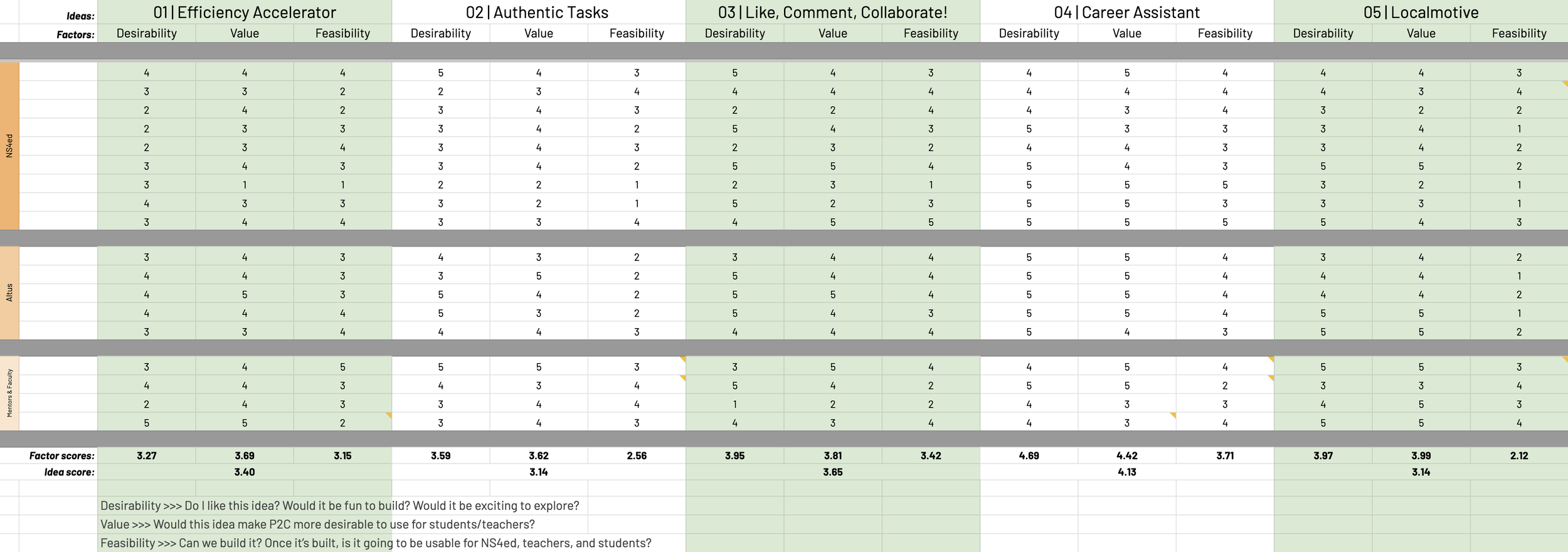
I designed a weighted voting structure for the decision meeting. Eighteen participants joined: nine client staff (collectively weighted at 45% of the vote), our five team members (40%), and four mentors (15%). Each pitch was scored on three factors: desirability (10%), value (45%), and feasibility (45%). The client agreed in advance that the tool would be used to make a decision during the meeting itself, not as an advisory input.
During this 2.5 hour meeting, we opened with a presentation of work to date, then ran a workshop in three parts:
Small-group discussion (each group included one Altus member and 2-3 other participants, discussing student value, teacher value, roadblocks, end product, and other considerations)
Recommendation sharing from each group
The vote and direction setting for the remainder of the project
By the end of the meeting, we reached a decision to pursue the career assistant pitch outlined in the storyboard above. The voting tool is displayed below. Names have been hidden for privacy.
Product Development & Delivery
Having landed on the career assistant pitch, we moved into iterative development. We completed three rounds of development with client feedback integrated at each stage, and ran user testing to validate the designs before final delivery. The final product, delivered in August 2022, was a virtual agent, Pearl, (shown below) paired with three core features:
Onboarding Guidance (Video Walkthrough)
Profile Dashboard (Video Walkthrough)
Opportunities Matching (Video Walkthrough)